Wednesday, September 27, 2017

Sign Up for The Carlat Report's Free Quick Tips Newsletter


The Carlat Report Newsletters are launching a bi-monthly email newsletter that will contain concise, practical advice for busy clinicians based on the work we are doing in The Carlat Report, The Carlat Child Report, and The Carlat Addiction Treatment Report.
You don't have to be a paid subscriber to get it, simply fill out this quick webform and you'll start receiving each new issue, along with special offers and information on the latest books and courses.

Tuesday, September 12, 2017

Hating on Antipsychotics: Are We Going Too Far?

Antipsychotics are not perfect. No drugs are. They can cause weight gain and weird movement side effects and sleepiness. But they have their uses, such as quelling racing thoughts, inner turmoil, and psychosis. There’s nothing inherently good or bad about any class of drugs. It’s up to physicians to understand the data and to prescribe medications judiciously.

With that introduction out of the way, let me describe for you a recent study that was published in the July 11 issue of JAMA. It’s called the VAST-D trial, which stands for “VA Augmentation and Switching Treatments for Improving Depression Outcomes”. In this study, researchers randomly assigned 1522 patients to thee treatments: 1. Switch from the current antidepressant to bupropion; 2. Continue the current antidepressant, and add bupropion; 3. Continue the current antidepressant and add aripiprazole (a second-generation antipsychotic that is FDA approved for adjunctive use in depression). (By the way, the study was not funded by aripiprazole’s makers, and the medication is now available in a low cost generic form).

 After 12 weeks of treatment, the aripiprazole augmentation group fared somewhat better than the others:
Outcome at 12 weeks
Aripiprazole augmentation
Bupropion augmentation
Bupropion switch
Remission rate
29% (statistically superior to bup switch)
27%
22%
Response rate
74% (statistically superior to bup switch and augmentation)
66%
62%

Aripiprazole augmentation yielded a higher remission rate than switching to bupropion, and it produced a higher response rate than either one of the bupropion strategies. But let’s look at side effects—some were more common in the aripiprazole group, others in the bupropion group. Side

Effects Statistically More Common in the Aripiprazole Group:

Side Effects
Aripiprazole augmentation
Bupropion augmentation
Bupropion switch
Akathisia
14.9%
5.3%
4.3%
Somnolence
14.5%
7.9%
7.2%
Weight increased by at least 7% at 12 weeks
9.5%
1.9%
2.3%
Weight increased by at least 7% at 36 weeks
25.2%
5.2%
5.2%

Side Effects Statistically More Common in the Bupropion Groups:

Side Effects
Aripiprazole augmentation
Bupropion augmentation
Bupropion switch
Anxiety
16.6%
22.5%
24.3%
Tremor
3.8%
10.3%
6.1%

Basically, bupropion caused more anxiety and tremor, while aripiprazole caused more weight gain, tiredness, and akathisia (a feeling of inner restlessness often caused by antipsychotics). Now, although aripiprazole caused more side effects, patients seemed to be less bothered by these side effects than those in the other treatment groups—at least as measured by the percentage of patients who withdrew from the study due to side effects. Only 5.3% of the aripiprazole patients withdrew because of side effects, as opposed to 7.3% in the bupropion augmentation group, and 10% in the bupropion switch group.

If you want to quibble with the results, there are a lot of details about the study that you can pick apart. And as is true for just about any large study, these would be reasonable points. But for me as a clinician, the bottom line is that this is the first large truly randomized study comparing antipsychotic augmentation with two other very common strategies for patients who don’t respond to the first antidepressant. And the results pretty clearly show that aripiprazole augmentation is somewhat more effective than the two other methods tested. This doesn’t mean that suddenly all my patients are going to be on aripiprazole. A quarter of patients had significant weight gain after 9 months, and about 15% had akathisia. Those can be problems, but in clinical practice, you monitor for side effects, and if they are bad, you stop the offending medication and try something else. That’s a risk/benefit decision . . . and this study implies that aripiprazole should be high on your options for treatment resistant depression.

But here’s the thing: Nobody seems to want to admit that it works.

 On Medpage Today’s Slow Medicine blog, the focus was on the side effects of aripiprazole, and how this study will definitely not convince them to use aripiprazole.

 Their commentary was titled “No Atypical Antipsychotics for Depression,” and they concluded with: “In the face of uncertainty, our Slow Medicine philosophy favors the safer, more conservative approach. VAST-D will not change our practice. Until we see clear evidence of benefits that outweigh the harms, we don't see a role for antipsychotics for most patients with depression. For now, among patients with an inadequate response to a first antidepressant, we'll try a second antidepressant, consider enhancing behavioral therapy, or think about augmenting with the safer medication, buproprion.”

Given that their philosophy is to avoid quick fixes and take a cautious approach to new treatments, I can understand this coming from Slow Medicine. But even the authors of the original JAMA article took pains to downplay the results. Here’s their conclusion:

 “Among a predominantly male population with major depressive disorder unresponsive to antidepressant treatment, augmentation with aripiprazole resulted in a statistically significant but only modestly increased likelihood of remission during 12 weeks of treatment compared with switching to bupropion monotherapy. Given the small effect size and adverse effects associated with aripiprazole, further analysis including cost-effectiveness is needed to understand the net utility of this approach.”

Really? First, they’re reminding us that we can’t generalize the results beyond the population studied (okay, we got that, it is, after all, a study of vets). Second, they are pretending that response rate was not one of the pre-specified outcome variables (it was a secondary outcome, but based on the same depression scale used for the primary outcome), and therefore they are making believe that there’s no evidence that aripiprazole was better than bupropion augmentation, not just better than switching. And finally, there’s this bizarre indirect way of saying “these results are unimpressive, don’t change your practice.” (I guess that’s what they mean by “net utility”).

 Dudes, this was a major study, and you got an interesting, clinically relevant, result!

It’s okay to brag a little. Let’s go where the data take us, even if we’ve become accustomed to hating on the drugs that come out on top.

Wednesday, September 6, 2017

We're Diagnosing Like It's 1799

The fact that psychiatry lags far behind the rest of medicine scientifically is no great news flash. The leaders of our field have long acknowledged this problem (see, for example, this withering self-critique by then head of NIMH Thomas Insel).  None of this should be taken personally. Psychiatrists are just as smart as other doctors. It’s just that we have the misfortune of having chosen the most complicated organ to study—the brain.

Nonetheless, occasionally I come across information that reminds me anew of just how far in the dark ages we are stuck. This happened a couple of weeks ago when I was binge-listening to podcasts and happened upon this great episode of the 99% invisible podcast about the origin of the stethoscope.

The stethoscope was invented in 1816 by a 35 year old Parisian physician, RenĂ© Laennec. Laennec was particularly interested in “diseases of the chest” as they were called then, and especially tuberculosis, which was ravaging Paris and had a 50% death rate. Doctors knew a little bit about how TB affected the lungs based on autopsy findings. But they didn’t have clue that what caused it (that would have to wait until 1882 when Robert Koch discovered mycobacterium tuberculosis), and they had a very hard time diagnosing the disease in a living person. TB causes symptoms such as dyspnea (shortness of breath), coughing up blood, weight loss, and fever, but many patients with other diseases presented similarly. Doctors had no diagnostic tools or blood tests, and depended on having long talks with patients about their symptoms and history. But conversations about an illness only got them so far, and commonly the final diagnosis was simply “dyspnea” or “fever”—which we now know are symptoms with various underlying causes, but which in the 18th century were thought of as diseases.

A medical transformation was borne one day when Dr. Laennec was examining an overweight woman with dyspnea. Based on their conversation, Laennec could not distinguish TB, pneumonia, or heart disease. He tried chest percussion, a popular method that helps detect whether areas of the lung are filled with inflammatory fluid, but the abundance of tissue rendered that technique unhelpful. He was tempted to simply place his ear on her chest—a technique called “immediate auscultation,” but felt that it was “indelicate” to do so. He looked around and, in his words, “grabbed 24 sheets of paper, rolled them tightly into a bundle, and secured them in shape with paste glue.” Using this cylinder, he placed one end onto her chest, and other to his ear.  He was “delighted” to find that he could hear heart and breath sounds with amazing clarity.

Laennec refined the device over the next several years, hiring a carpenter to build better versions out of wood, and he shared his discovery with colleagues. Armed with the stethoscope, doctors carefully correlated breath and heart sounds of dying patients with autopsy findings, eventually reporting a series of “pathognomonic” sounds that could, with a good degree of certainty, diagnose specific diseases. Whereas patients were once told that their disease was “dyspnea,” they could now learn which organ was affected, and what the likely prognosis was. Unfortunately, effective treatment had to wait for the discovery of antibiotics and cardiac drugs.

In psychiatry, diagnostically we are squarely in the pre-Laennec era (though therapeutically, we have serendipitously discovered highly effective treatments for many disorders). We diagnose such entities as “major depression” and “schizophrenia” based on prolonged conversations with patients, conversations termed “mental status exams.” We combine our observations with the history to discover clusters of symptoms that often occur together, and which are therefore included as “disorders” in the DSM-5. But, like physicians in 1799, we don’t understand how the pathology of the underlying organ leads to these symptoms. In fact, our science is arguably considerably more primitive than 1799 medicine, because even our autopsy results have not identified any lesions responsible for psychiatric symptoms—with the exception of Alzheimer’s disease.

Psychiatry does not have a stethoscope. We have ancillary technologies, such as MRIs, PET scans, EEGs, and blood tests, all of which can effectively rule out other diseases that can mimic psychiatric disorders. But we can’t peer into our patient’s brain to tell them what lesion or circuit mishap causes them to suffer as they do.

We need to acknowledge that a careful interview is not only central to psychiatric diagnosis, but is the only method we currently have in our diagnostic tool box. If we really want to help our patients, we need to enhance our skills at asking the right questions and understanding the meanings of the answers. Which may well take more time than insurance companies believe we are worth.

Tuesday, August 29, 2017

Ecstasy for PTSD: Some Background

You may have heard that the Food and Drug Administration has given the drug ecstasy (MDMA) its "breakthrough designation" for the treatment of PTSD. See this very thoughtful article in the Washington Post for details. 

I came out of blog-slumber to post about this because we're in the midst of planning an upcoming issue of TCPR (The Carlat Psychiatry Report) on PTSD, and because we've recently published a fair amount of material about MDMA. 

First, here's why we need better PTSD treatments. Only two drugs are FDA approved for PTSD: Paxil and Zoloft. Neither are very effective. In the original FDA trials, the drugs beat placebo but not by much; in fact, about 80% of the drug's efficacy is likely due to placebo factors. (See an older issue of TCPR for more on these trials). Various other drugs are used off label, such as Prazosin which helps with insomnia and nightmares, atypical antipsychotics, and alpha agonists such as clonidine and guanfacine. 

Psychotherapy is more effective than drugs, though the treatments most validated are imperfect and are variations of exposure therapy. Patients are asked to recount the trauma over and over again until they are desensitized to the anxiety elicited by the memory. The problem is that this process is emotionally painful and many patients just can't bear the idea of having to recall their trauma (such as a rape, a military attack, or a natural catastrophe) repetitively. 

Enter MDMA. Last March we published an issue of CATR (The Carlat Addiction Treatment Report) on psychiatric uses of street drugs. Psychiatrist Philip Wolfson wrote an overview of the many therapeutic uses of hallucinogens and other substances (full article here), and we interviewed the training project manager of the MDMA/PTSD research program, Shannon Clare Petitt (full interview here). I've reproduced a portion of Petitt's interview at the end of my post below. These are clearly boom times for those seeking creative ways to repurpose "recreational" drugs for healing purposes. In my opinion, that's a good thing for psychiatry, as we have been in something of a pharmacological rut for many years now. 

Excerpt from "MDMA-Assisted Psychotherapy for Posttraumatic Stress Disorder", an interview with Shannon Clare Petitt, MA, first published in The Carlat Addiction Treatment Report, Vol 5, No. 2, March/April 2017. Ms. Petitt is the MDMA therapy training program manager at MAPS Public Benefit Corporation (MPBC), Santa Cruz, CA.
CATR: You work for MPBC, MAPS Public Benefit Corporation, a subsidiary of the Multidisciplinary Association for Psychedelic Studies, as MDMA therapy training program manager. What does your work involve?
S. Petitt: My work is focused on managing the program that selects and trains researchers for the MDMA-assisted psychotherapy protocols MPBC is conducting. As you might imagine, it’s important to select applicants who have experience working with trauma and are truly well suited for MDMA-assisted psychotherapy. Over the past year, we have reviewed 300 applicants, and right now we are in the midst of training 80 people who will work on therapy teams for Phase 3 trials. In addition to the training program, I also served as co-therapist on the MAPS-sponsored Phase 2 trial of MDMA-assisted psychotherapy for anxiety associated with life-threatening illness.
CATR: Most people know MDMA as “ecstasy,” a drug of abuse. How does it assist in psychotherapy?
S. Petitt: We have two main hypotheses that drive our research. The first is that MDMA reduces activity in the amygdala, which is the fear center of the brain. This is supported by animal research showing MDMA facilitates fear extinction learning. This is important because the hallmark of PTSD is reexperiencing—feeling as though the traumatic experience that happened in the past is actually happening in the present moment. MDMA allows people to recall traumatic memories without the same fear response, and of course this makes it much easier to process and recontextualize those memories.
CATR: It sounds like MDMA helps make recalling traumatic memories less aversive. What’s the second hypothesis?
S. Petitt: It’s relational. Working with trauma is about establishing trust and safety, and MDMA facilitates that.
CATR: In what way?
S. Petitt: MDMA is not a classic psychedelic that induces hallucinations or distortions. It’s better described as an empathogen, or some people call it an entactogen, because it produces feelings of compassion for oneself and others and helps establish trust. It’s so effective in this area that it was actually used in couples therapy before it became illegal in the U.S.

Friday, February 17, 2017

Antidepressant News: Just the Right Amount of Opiate?

In the early 1950s, opium was considered an effective treatment for depression, but gradually it fell out of favor as its addiction risk became clear. Nonetheless, there's no denying that opioids rapidly elevate the mood of just about anybody, even the very depressed. So that's a pretty tantalizing challenge: Is it possible to harness the elating effects of opiates while avoiding the addictive "side effects," as it were.

source: amrismartsourcing.com
A recent contender is a drug made by Alkermes code named ALKS 5461. This drug is a combination of buprenorphine and samidorphan. Buprenorphine is an opioid which is often combined with naltrexone to produce drugs for opioid use disorder, such as Suboxone. Samidorphan is a derivative of naltrexone, and it doesn't antagonize opioid receptors quite as avidly as its cousin. So combining these two might just allow enough opioid receptor stimulation to squeeze through to treat depression, without it being too appealing to potential addicts.

Early phase I and phase II clinical trials with small numbers of subjects were promising. Based on these results, the company conducted larger phase III trials, called the FORWARD (Focused On Results With A Rethinking of Depression) trials. Unfortunately, the first two of the larger trials failed, showing no improvement over placebo. The third trial (FORWARD-5) was more successful. In that trial, 407 patients with depression unresponsive to a trial of standard antidepressants were randomized to receive ALKS 5461 as an adjunct, or placebo as an adjunct. The company reports that patients receiving the higher dose of 2mg of ALKS 5461 did significantly better than placebo, as measured by the MADRS rating scale. Side effects were nausea, dizziness, and fatigue.

Will this drug see the light of day? It’s unclear, but according to pharmaceutical industry news sources, Alkermes has been talking up its latest results with the FDA and hopes to get approval at some point within a year or two. It sure would be nice to have another antidepressant at our disposal.

Wednesday, September 7, 2016

Have Companies Stopped Ghostwriting? BMJ Article Says "No"

A new article in the British Medical Journal (BMJ) by Alastair Matheson takes a fresh look at ghostwriting in medical research. Apparently, pharmaceutical companies are waging a campaign to convince us that they are now opposed to ghostwriting. But Matheson argues that the practice continues, only under a different name: "editorial assistance."

It comes down to how we define ghostwriting. The standard definition in the Oxford dictionary is straightforward: a ghostwriter is “a person whose job it is to write material for someone else who is the named author."

If a company recruits academics to put their names on a paper, but then pays an unnamed medical writer to actually compose the paper, that's clearly ghostwriting and is a deceptive practice. But it's rarely so straightforward. Yes, companies recruit academics to help design, conduct, and write research studies. Yes, companies also hire medical writers to do the grunt work of writing up the results of a study. Typically, medical writers are acknowledged in small print in the footnotes. Companies are claiming that this acknowledgment means they are being honest, and properly informing readers that these non-academics also contributed to the paper. Therefore, they are innocent of ghostwriting.

Matheson disagrees, arguing that these medical writers do a lot more than just the tedious rendering of the methods and results of research. Instead, they work closely with the funding companies to shape the manuscript in such a way that the funded drug looks good. The identified authors, whose names are in lights just below the title, may indeed edit and review the paper before publication, but the companies have plenty of leverage over the final content.

Simply publishing a footnoted acknowledgment of a medical writer for "editorial assistance" is not enough, he says, because it covers up a process in which the company uses the medical writer as a conduit to spin the paper in a commercial way. The solution? The International Committee of Medical Journal Editors (ICMJE) should require that any writer who contributes to the manuscript should be listed as an official author. He points out that the journal Neurology already has this policy in place, and indeed, if you look up their authorship policy here, you'll find the following crystal clear statement:

"Professional writers employed by pharmaceutical companies or other academic, governmental, or commercial entities who have drafted or revised the intellectual content of the paper must be included as authors."

Furthermore, Matheson calls for ICMJE to develop other rules to prevent what he calls "attributional spin." For example, in deciding the order of the listed authors, those with the most actual influence over content (often the employees of the company) should be listed first, rather than being listed after the academics as is sometimes done.

It's a good read. The article piqued my curiosity because over the last few days I've been slogging through the literature on antidepressant-induced sexual dysfunction to write an article for the next issue of the Carlat Psychiatry Report. Most of the articles are industry funded, and all of them relegate mention of medical writers to footnotes.

For example, here's page 1 of one of the studies I've read. There are five authors, the first of whom is an independent academic, and the last four are employees of vilazodone's maker Forest.


And here's the last page of the paper, which acknowledges Adam Ruth, a medical writer, for "writing assistance and editorial support."


According to Matheson, Adam Ruth should be listed as an author. I agree.

It's true that in this particular case, you could argue that Forest is already being transparent enough by clearly stating that four of  the authors are company employees. Nonetheless, adding the medical writer as an author reminds the reader that industry funded articles are essentially commercial, rather than academic enterprises. Maybe that's obvious, but sometimes it's worth stating the obvious.


Monday, October 5, 2015

Boston Globe Article about Genetic Testing in Psychiatry


It would be fantastic to have a lab test to help us decide which drugs to prescribe in psychiatry. See Sunday's great Boston Globe article that picked up on our recent coverage of the GeneSight test


It's a promising technology, but the marketing has leap-frogged ahead of the science. 

This Wednesday afternoon I will be participating in a webcast with journalists and other doctors about this controversial issue. 

The chat will begin this Wednesday, 10/7, from 3:30 p.m. to 4:30 p.m. The conversation will appear in the embed below and on the New England Center for Investigative reporting page here. You can start submitting questions now though.

Live Blog What should you know about psychiatric genetic testing?

Wednesday, September 16, 2015

The TMS Wars: Psychiatry Goes High Tech

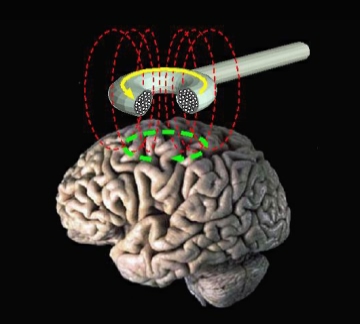
In the pages of The Carlat Psychiatry Report, we’ve covered transcranial magnetic stimulation (TMS) numerous times—most recently in the current issue. For those who haven’t heard of these devices, they work by pulsing magnetic fields into the brain. The magnetic fields stimulate neurons—far more gently than electroconvulsive therapy. The theory is that this gentle brain stimulation, focused on specific brain regions, eases depression.

After skeptically covering this technology for almost a decade, I’m finally convinced that it actually works.  A recent systematic review, funded by the U.S. Government and written by authors with no ties to any TMS company, endorsed the technology pretty strongly. They found that for patients who were treatment resistant (those who had not responded to at least two antidepressants), TMS was three times as effective as the sham (placebo) control group.

Admittedly, it’s a little creepy and science-fictiony that we are in an era when magnetic stimulators are actually effective for changing our moods. But so be it.

Now that we have an effective device in psychiatry, it’s kind of fun to see these manufacturers competing for market share. There are already two TMS devices on the market: NeuroStar and Brainsway.

Over the past couple of months, two new companies have jumped into the fray. I received this letter from a company called Magstim, announcing their new Rapid 2 Therapy System. Without going into too many technical details, this device, as you can see below, looks like a glorified dental chair with a sleek brain stimulator attached.

Magstim

MagVita
MagVita is an even newer device, just approved last month.

As is turns out, these two upstarts are threatening to shake the nascent TMS industry to its core. Why? Because they are entering the market with an offer that’s almost impossible to refuse: no per-use fee. Both Neurostar and Brainsway charge a bundle of money up front to buy or lease the device, then they charge an extra $100 or so per treatment for disposable “shields” which aren’t actually necessary. They are simply income generators.

Magstim and MagVita are chucking those shields—saving doctors thousands of dollars in pointless charges.

What does this mean for patients? Probably that the treatments will be more affordable—more insurers will cover the cheaper Magstim and MagVita devices, and patients who must pay out of pocket will have less sticker shock. And what does this mean for Neurostar and Brainsway? Lots of anxiety, and deep discounts to try to keep up with Magstim and MagVita.


Want to learn more about neurostimulation devices? 
The July/August issue on “Interventional Psychiatry” offers an overview of this fast-changing world and is available as an individual purchase which includes 2 category 1 CME credits.
  • Summary of neurostimulation methods, including: transcranial magnetic stimulation (TMS), magnetic seizure therapy (MST), vagus nerve stimulation (VNS), transcutaneous vagal nerve stimulation (tVNS), transcranial direct current stimulation (tDCS).
  • Expert Q&A on the past and future of TMS with Dr. Mark George of the Brain Stimulation Laboratory at the Medical University of South Carolina.
  • Expert Q&A on what it means to be an "interventional psychiatrist" with Dr. Nolan Williams of Stanford University.
  • Review of the Fisher Wallace and Alpha-Stim devices as treatment options for depression.
  • A practical guide on which TMS device you should buy (if any) for your practice.

Thursday, August 20, 2015

Flibanserin: 5 Things to Consider Before Passing Judgment on the “Female Viagra”


Flibanserin (brand name Addyi) has just received a controversial and complicated FDA approval for the treatment of low sex drive in women. There’s a lot of outrage in the blogosphere, much of it centered on the lobbying of the FDA by disease advocacy groups.  I agree that this politicization of what should be a scientific process is embarrassing to both Sprout and its supporters. Nonetheless, I'm not nearly as hard on flibanserin as some of my colleagues.

Here’s why.

1. Hypoactive Sexual Desire Disorder is as real as any other source of distress, and deserves treatment.
 
Sure, I get that when it comes to subjective problems, it’s easy to stretch the definition of what constitutes a disease. But who are we to judge whether an affliction is severe enough to merit treatment? An example is social anxiety disorder. Some call it the medicalization of shyness. But if you’ve ever treated someone with this problem, you know that extreme shyness can limit your potential for a normal, happy life.

Low sexual desire may not be a public health emergency, but it’s a real problem for about 10% of women.  If they want to take a pill to make their lives a little better, why not? We allow Botox for wrinkled eyebrows, Rogaine for hair loss, Provigil for jet lag. Why not a drug for low sexual desire?

2. Flibanserin is a female Viagra—just a much less effective version. 

Lots of bloggers are saying that Flibanserin is no female Viagra. I don’t buy it. Trivially, yes, they are different drugs because they have different mechanisms of action. Viagra and the rest of the PDE-5 inhibitors enhance erection by shunting more blood to the vessels of the penis. Addyi’s specific mechanism isn’t known, but the drug is a serotonin 1A receptor agonist and a serotonin 2A receptor antagonist and enhances sex via greater desire. But the purpose of both drugs is the same—they are supposed to improve peoples' sex lives. Whether they do it via blood flow or serotonin doesn’t really matter.

However, there is one huge difference between Viagra and Addyi—namely, Viagra is extraordinarily more effective than flibanserin. Studies of Viagra and other PDE-5 inhibitors have found that around 80% of men on the active drug report erectile improvements vs. 20-30% of men taking placebo. That means that 50-60% of men gain benefit over and above placebo. Flibanserin? The FDA’s analysis of the data concluded that 8-13% of women had some desire benefit beyond the effects of placebo. If Viagra is a Starbuck’s triple espresso, flibanserin is a Dixie cup of cafeteria coffee.

3. Flibanserin causes side effects. In addition, water is wet. 

Come on, the nature of all medical treatment is a balance between benefits and side effects. Antipsychotics cause weight gain, antidepressants cause impotence, Viagra causes lightheadedness and low blood pressure especially if combined with nitrates. Flibanserin causes side effects too, such as sedation, dizziness, and low blood pressure.

There’s also an interaction with alcohol but we don’t know how dangerous it is. The company did a study of 25 people (most of whom, oddly enough, were men), and found that one person fainted when combining flibanserin with a moderate amount of alcohol. Five people got dizzy on the combination, but three people also got dizzy in the alcohol plus placebo group, and 4 got dizzy with flibanserin alone. (For the results of the Alcohol Study, see page 77 of this PDF report.)

So it’s not clear from these data how concerned we should be. Certainly, Sprout needs to do more studies. An alcohol contraindication is reasonable. Do we really need to limit flibanserin scripts to certified prescribers? Do we really need a REMS, and the requirements for CME that will inevitably be funded by the manufacturer? It sounds like a case of FDA over-reaction to me. I’ve been prescribing MAOI antidepressants (another "dangerous" drug) to patients for years. There’s a long list of foods they can’t eat and meds they can’t use. Our discussion of side effects is part of a standard medical visit. I don’t need a special certification to talk to my patients about these things.


4. Flibanserin will, indeed, be prescribed off-label, just like virtually every other FDA-approved medication. 

The FDA indication for flibanserin is highly restricted. It’s indicated only if there is low sexual desire without any clear cause. Thus, if the patient is depressed or anxious, and you think that may be contributing toward the low desire, it’s off-label. If there’s a medical condition, like cancer, causing the problem, it’s off-label. It's undoubtedly true that in the real world, doctors are going to be prescribing the drug for these off-label populations and many more. That’s no different from most other meds we prescribe. In psychiatry, for example, almost all the medications we prescribe for children are off-label, because there are so few meds with FDA approval.

5. Adriane Fugh Berman said it best as quoted by the New York Times: Flibanserin is a “mediocre aphrodisiac with scary side effects.”
 
But often in medicine, that’s exactly what we have to work with: mildly effective medications with side effects. Flibanserin may be mediocre, but it’s not ineffective. I look forward to cautiously prescribing it to those women in my practice who might benefit from it. Time will tell whether it becomes popular. If it’s as mediocre as the data suggests, patients won’t refill their prescriptions—in which case the market will quietly close the door on the little pink pill.


Wednesday, August 5, 2015

Vyvanse: Is History Repeating Itself?

One of the benefits of having the Carlat World Headquarters here in beautiful Newburyport, Massachusetts is that we get to work next door to an iconic antiques barn called Oldies. It's a wonderful stockpile of odds and ends that range from decommissioned lobster traps to faded movie posters.


The other day I came across an old issue of LIFE Magazine with a cover story on “The Dangerous Diet Pills: How Millions of Women are Risking their Health with Fat Doctors.” The date? January 26, 1968, which was smack dab in the middle of the amphetamine epidemic that prompted Congress to pass the bill creating our current system of scheduled, and controlled medications.


What, if anything, does this issue of LIFE teach us about the potential dangers of Vyvanse’s recent approval for binged eating disorder? This “exclusive report” was based on investigative journalist Susan McBee’s undercover visits to 10 “fat doctors.” She was given cursory exams and, although she was not overweight (5’5”, 125 pounds), virtually every physician prescribed her various pills, including amphetamines, barbituates, sex hormones, and diuretics. One office insisted she pay cash--no personal checks--in order to receive the pills.

How is this nearly 50-year-old article relevant to the age of Vyvanse? This was a story of unscrupulous doctors running pill mills for women who wanted to lose weight. The diagnostic process--if there was one--was sloppy and all-inclusive. If you came to one of these doctors requesting amphetamine, you were assured of getting a script, regardless of your diagnosis.

As a recent New York Times article shows, history is repeating itself. The Affordable Care Act has a provision requiring coverage of obesity treatment, and doctors are taking advantage of this by opening chains of lucrative weight loss clinics. Some are selling medications directly to patients, such as phentermine, which, like Vyvanse, is an stimulant.

It seems only a matter a time before Vyvanse pops up in the menu of options for patients being seen by the new breed of diet doctors.

Don't get me wrong--Vyvanse is effective for binge eating disorder, as we discussed in our recent CME article (subscribers to The Carlat Psychiatry Report can read it here).

If a patient came to me and said, “Doctor, I’ve heard about Vyvanse for binge eating, and I’d like to try it,” I would carefully ask about their eating habits in order to establish an actual pattern of binge eating. But what if the patient was more of a grazer than a binger? What if I sensed that the patient was simply looking for a weight loss drug and had no binge eating problem at all? I wouldn't prescribe a drug that has a high risk of abuse and diversion.

As was true in 1968, doctors are free to prescribe meds for indications not approved by the FDA. I predict that many women (and men) will be asking for Vyvanse to lose weight, and will walk away with the prescription, whether or not they have BED.

It's been nearly a half century since the LIFE article, and we're still prescribing speed for weight loss Let’s not let it get out of hand.

Wednesday, July 1, 2015

Hospitality and Pharma: Relationship on the Rocks?

Decades of mutually beneficial economic ties have bound the fortunes of hotels, restaurants, and drug companies. But in an era of Sunshine Act disclosure, renewed calls for professional ethics, and ballooning healthcare costs, that relationship may be souring.

It used to be a veritable love-fest. As recently as 2011, I was writing about a restaurant's attempt to rebrand itself as a "pharmaceutical dinner facility."  In 2010, I debated a restaurant chain owner who was calling for the Massachusetts legislature to repeal the state's 2009 gift ban so drug companies could once again wine and dine doctors at his restaurants. His lobbying turned out to be successful. The state's previously strict law was revised in 2012. Now it allows industry representatives to purchase meals of a "modest value" outside the office or hospital as long as they provide educational information about their products between courses.

However, it turns out that while hospitality industry owners are working double time to book reservations for doctors and pharmaceutical reps, their employees have an entirely different idea. They--correctly--see drug company relationships with doctors as a driving force in their rising health care costs, and they want pharmaceutical companies to stop funding educational CME programs at their hotels.

Last week I wrote about this brave stance from the hospitality worker's union Unite Here ("Hotel Workers Against Industry-Funded CME?"). The Wall Street Journal​'s Pharmalot blog got in touch with me to discuss the matter further and yesterday they posted a follow up that includes more of my thoughts on the matter and more of ACCME's self-serving response.

Looking back over the recent history of these industry dynamics, it's easy to see more workers taking this stand against business as usual. After all, they go to work every day in the middle of a money storm while simultaneously seeing their health costs rise year after year. That's a pretty good reason for them to want to stand up.

You can help them out by signing the No More Drug Money petition they are promoting and by sharing it around.

Friday, June 26, 2015

Hotel Workers Against Industry-Funded CME?

In a fascinating new chapter in the battle over industry funding of CME, a huge hotel workers' union has started a campaign to end the practice. Unite Here represents 270,000 workers, and the organization claims that industry funding of CME drives up their health care costs, which is undoubtedly true. So they have created a website, No More Drug Money, to advocate their cause, and they are inviting us all to sign the Pledge: "Add your name here to encourage the ACCME to kick drug money out of CME for good."

You have to respect an organization willing to bite the hand that feeds them. Hotel workers are, after all, an integral part of the grand machinery transporting industry marketing messages into the hearts and minds of doctors. They're quite aware of this:

"We work in hotels, airports, and convention centers, and we do the hard work that make many CME meetings run. We cook the food, we change the sheets, we do the laundry, and we pass out the agendas. We see first-hand what kind of presence pharmaceutical companies have during these meetings. And we are ready for a better system."

For ACCME's formulaic response, click here.

Industry funding of medical education, whether accredited CME or promotional talks, has always created strange bedfellows, but now it has created particularly strange antagonists.

Sunday, May 17, 2015

The GeneSight Test: A Wing, a Prayer and 13 Patients

We just published the May issue of The Carlat Psychiatry Report, and the topic is "Biomarkers in Psychiatry."

I contributed an article reviewing the evidence for the GeneSight genetic test, which is being quite heavily marketed as a way to choose the right medications for patients. According to company's website:

"Multiple clinical studies have shown that when clinicians used GeneSight to help guide treatment decisions, patients were twice as likely to respond to the selected medication."


That's misleading, I found. The vast majority of the GeneSight data are based on studies with an unreliable methodology. These were so-called "open label" studies in which patients were non-randomly assigned to two groups: guided treatment vs. unguided treatment. All patients and clinicians knew which patients were assigned to which group, leading to the very real possibility of various biases--along with a heavy helping of the placebo effect.

One single randomized, blinded study has been published (not even properly blinded, since the clinicians knew which patients were in which group). It enrolled 49 patients (25 in the guided group, 24 in the unguided group). There was no significant difference in the depression improvement scores between the groups. There was a secondary analysis of 13 patients showing a potential benefit for those whose meds were categorized by the test as being particularly problematic.

13 patients? I don't think I would use a genetic test based on good results from an N of 13--and I would suggest that you think twice before you do so!

By the way, I'm at the APA meeting in Toronto and will be going to a lecture today sponsored by Assurex, the maker of GeneSight--if I learn anything new I'll let you know.


Thursday, April 30, 2015

How Drugs Collide: What Every Psychiatric Prescriber Should Know

Please file this blog post under "Shameless Self-Promotion."

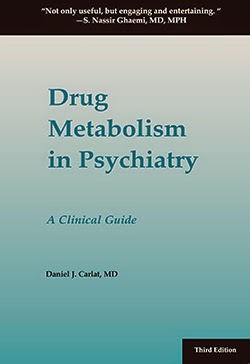
I just published a new edition of my book, Drug Metabolism in Psychiatry: A Clinical Guide. You can buy it here, and you can read a free preview of the first two chapters here.

It's mostly a book for psychiatrists and psychiatric nurse practitioners. It's pretty short at 145 pages, but it's very concise and in my opinion fun to read.

If you are not a prescriber you might also find it useful because it explains in clear language how we make decisions about which drugs to prescribe based on how they are metabolized. Therapists, patients, and those simply interested in psychiatry might find it educational, and strangely entertaining.

Anyway, that's it. Sorry if you were looking for a piece of muckraking investigative journalism. Maybe next time!

Thursday, April 16, 2015

How a New Blood Test for Depression is like Apple Recognition

Four years ago I wrote a blog post about the MDDScore blood test for depression. That was before there were any peer-reviewed publications describing it. Now there are at least two. The latest came out a couple of months ago in the Journal of Clinical Psychiatry, and you can access the article, along with two interesting commentaries, for free.

While I won't go into the article in any detail, suffice it to say that the overall accuracy of the test for diagnosing depression was between 91% to 94%, depending on the group studied. Based on this, the authors report that the test "has excellent performance in confirming a diagnosis of MDD (major depressive disorder)."

The article is a classic example of the pitfalls of focusing on glitzy-sounding statistics while downplaying the actual clinical usefulness, which in this case is close to nil, as both of the Journal's commentators agreed.

I recently discussed the same problem in an article I wrote for CCPR about the NEBA EEG test for ADHD. Like the MDDScore, the NEBA test promises to aid in the diagnosis of a psychiatric illness. The NEBA's accuracy is high, with a positive predictive value for ADHD of 96% for kids, and 81% for adolescents. But no matter how accurate it is, the crucial question is whether it adds value above and beyond the standard psychiatric interview. Neither the MDDScore nor the NEBA do.

In my article, I used a hypothetical analogy of a new test to diagnose apples:

"Let’s imagine that there’s a new apple-recognizing device on the market called the “Apple Rec,” which uses various technologies to measure the wavelength of light reflected by an object, its mathematical curvature, etc. The manufacturer provides impressive data showing that the Apple Rec has 100% sensitivity and 100% specificity for diagnosing (recognizing) an object as being an apple. Given these dazzling statistics, would you buy the Apple Rec? No, because even though it’s exquisitely accurate, it provides you with no useful diagnostic information beyond what you can obtain by looking at the apple yourself. However, if the Apple Rec provided you with added value, you might consider it a good investment. For example, if, in addition to correctly recognizing it as an apple, it also calculated its sweetness and crispness, the Apple Rec suddenly becomes a useful tool, because these are qualities that you would otherwise struggle to ascertain."

The apple principal applies to diagnostic tests in psychiatry. Before you refer your patients to an expensive test that diagnoses ADHD, depression, or anything else, you need to make sure that it does something that you can’t easily do yourself.  


Wednesday, April 15, 2015

Medscape Presents: The Brintellix Show

As I wrote in part one of my Medscape review, the website gets high marks for up-to-the-minute coverage of psychiatric news, and it deserves kudos for posting a ton of textbook-like content on disorders and drugs. I wasn’t so thrilled with its "un-privacy" policy, which results in your personal info and browsing history being sold to third parties. 


Today we get into the dark side of Medscape Psychiatry, which is their industry-funded CME. 

Medscape Psychiatry CME Overview

Medscape offers four different categories of CME on its “CME and Education” page.  "Clinical Briefs" and "Journal Articles" are mostly not industry funded, whereas "Patient Cases" and "Knowledge and Practice" are generally industry products.  

Brintellix (vortioxetine) Background

To give you a little context, Brintellix is the latest antidepressant to be FDA approved. It is being marketed as a "multimodal" antidepressant because it has effects on several different receptor sites. The company has produced some interesting data showing that Brintellix may cause fewer sexual side effects than other antidepressants, and that it may help improve the slowed-down thinking that is common with depression. But it is not FDA approved for either of these potential advantages, because thus far, the data are far from definitive.

Medscape and Takeda/Lundbeck

Medscape is the largest single recipient of pharmaceutical CME grants among all U.S. medical communications companies. According to an article in JAMA, it received $20,315,730 in 2010, the last year for which such data were aggregated. I don't know how much the company is receiving from Takeda/Lundbeck for producing CME programs, but it's probably a lot. If you click through Medscape's most technologically sophisticated online courses, a high proportion are funded by this duo.

Here are some of the titles of the courses:

Commercial Bias in One of the Courses

All of the courses listed above are likely biased in favor of Brintellix--there wouldn't be much point in paying Medscape to produce them otherwise. Since blogging is not my day job, I chose only one of them to watch: The Pharmacology of MDD Treatment: Building a Foundation With a Focus on 5-HT.

This course begins with four multiple choice questions, which are supposed to test your knowledge before you learn. Here's one of them:

Which of the following antidepressants manipulates the most serotonin receptors at once?
vilazodone
selegiline
quetiapine
vortioxetine
The correct answer? Vortioxetine. 

This is a clever way to prime the pump, to get the audience thinking about the promoted drug.

Next, we get a slide purporting to give an overview of the history of antidepressant drug development.


The big red bubble labeled MMD refers to "multimodal drug", ie., vortioxetine. That's the latest one. The implication is that it's the most technically advanced. 

Later in the program, there are a few slides highlighting "new antidepressants." Only one antidepressant gets prominently featured on two slides:


The more crucial question is not "how many ways can one drug manipulate 5-HT" (even the manufacturer states the "clinical relevance" of the drug's many serotonin actions is "unknown") but rather "how many ways can one communication company manipulate doctors's prescribing practices?"

To make their point crystal clear, one of the experts in the video glowingly endorses Brintellix, saying that its multimodal mechanism is like packing a bunch of great medicines into one:

"Vortioxetine is a great example of this multimodal thing we were talking about. It is a serotonin reuptake inhibitor, but it also is a very strong agonist at 5-HT1A, which we said you want to have an agonist there. It also is a powerful antagonist at 5-HT3 which and a powerful antagonist at 5-HT7. On paper, here is a drug that has some of these qualities we have been talking about that could make it possibly a multimodal agent almost like a built in augmentation strategy in 1 pill, which certainly would be, just practically, a little easier for patients than having to take more than 1 medicine, which we often have to do.[3-6]"

A bit later, he goes even further, implying that Brintellix uniquely targets three common symptoms of depression:

"Again, right now, the data clearly show the 3 most common residual symptoms, even with people who have a response to an antidepressant are insomnia, cognitive impairment, and fatigue. I think those are things that are not well addressed by an SSRI alone. Thinking more sophisticated, multimodal actions whether it is 1 pill that has that built in augmentation. I think that is where the field is going."
Summing up Medscape
Since the last time I reviewed a psychiatric website, I assigned a letter grade, I'll give Medscape one as well: a B-. 
Why? It gets an A for delivering bite-sized psychiatric news clips on its non-CME page, an A- for providing free but dry drug and disorders info, and an F for failing to comply with Standard 5 of ACCME's Standards for Commercial Support in its CME courses. Among other things, Standard 5 forbids a CME program from promoting a "specific proprietatry business interest of a commercial interest", and it requires that presentations "must give a balanced view of therapeutic options." 
I'm surprised that Medscape is still resorting to these shenanigans, but I guess that's what butters their bread.