skip to main |
skip to sidebar
 Yesterday, I described a patient who experienced transient severe jitteriness and shakiness on Abilify 5 mg/day. She did not want to discontinue it yet, and as I mentioned, I'll provide an update when I see her next.
Today, I saw a woman in her 30s who has suffered recurrent depression and anxiety for years. I had recently added Wellbutrin SR to her Effexor XR and Klonopin. This seemed to help decrease her crying jags initially, but after a few months she became depressed and hopeless again. She was seeing her therapist regularly, but that wasn't doing the trick. So at her last visit in March, I had her discontinue the Wellbutrin and I added Abilify at 10 mg a day. Today, she said that she stopped the Abilify after 2 weeks, because "I felt like I was having 10 cups of coffee per day." She couldn't sleep, despite taking Ambien 10 mg at night.
Nonetheless, she feels less depressed today because over the couple of months since she stopped the Abilify, she began seeing her therapist more often, up to twice a week. She feels she has more perspective on some of her stressors (an ill father, financial difficulties).
She's doing okay, but this is another case in which the much vaunted Abilify fails as a augmentation for depression, and reveals its true colors as the antipsychotic most likely to cause akathisia. Clearly, starting her at 10 mg was a mistake, and when I use it in the future, I will start at the lowest possible dose, which is 2 mg.
Meanwhile, BMS is funding plenty of CME about using antipsychotics in depression and is making sure to contract with education companies that will hire key opinion leaders who can be depended upon to go easy on Abilify's side effects. For example, here is how Abilify's side effects are discussed by a noted academic in this online symposium created by CME, LLC:
"Adverse event dropouts; you always want to know, How well were these drugs tolerated? And in this first study it was pretty darned good. I mean, it looked very placebo-like in terms of ability to stay on the drug. The data for both studies when they’re put together in the package insert have a dropout rate of about 6% for aripiprazole. So it’s a bit higher than placebo. A lot of restlessness, a lot of akathisia, you know, people sort of a little bit unable to sort of stay still, but they could tolerate the drug. That’s 23%, 25% in the package insert. So some side effects, but overall pretty good tolerability."
Hmmm...."sort of a little bit unable to sort of stay still, but they could tolerate the drug." This is the beauty of industry-funded CME. You're not buying outright deception and therefore a public relations disaster, but you are buying someone who will handle your product's liabilities with kid gloves.
 Clin psych has posted this enlightening and relevant article about the efforts of Otsuka and Bristol-Myers Squibb to distract our attention from the major side effect of Abilify, which is akathisia. As he mentions, in the trials leading to Abilify's FDA approval for augmentation of antidepressants (you can watch one of their recent TV commercials here, but do so quickly, before BMS forces YouTube to take it off their site) the rate of akathisia, or extreme and debilitating restlessness, was 25% on Abilify as opposed to 4% in the placebo group.
Here's what Abilify's akathisia looks like outside of the scrubbed fantasy land of hired guns and PR companies. For several years I have treated a woman in her 40s with bipolar disorder who had been fairly stable on Tegretol, an anticonvulsant that is FDA approved for the treatment of manic episodes. But over the last few months, she has become involved in a pyramic marketing scheme and has ended up in serious debt. We both agreed this represented a manic episode, and decided to switch her from Tegretol to another medication, preferably one that did not cause any weight gain. She had not responded well to lithium in the past, Depakote and most of the atypical antipsychotics were out of the question because of their weight gain side effects, so I recommended a trial of Abilify.
"Let's start at 5 mg a day," I said, "then we can increase to 10 mg if we need to."
This was on a Thursday, and over the weekend, she left messages at my office saying that she felt incredibly "shaky," anxious, had insomnia, and just felt all around terrible. She didn't call my emergency coverage, but on Monday I spoke to her and found out that she had in fact increased the Abilify to 10 mg after a couple of days, clearly worsening her akathisia. I recommended she stop it, but she was reluctant, saying she wanted to give it a shot. So I prescribed the tranquilizer Klonopin, and told her to decrease the Abilify dose back to 5 mg. Over the next few days, she became less shaky, and calmer.
Her case is a work in progress, and I'll provide updates in the future. The point here is that this is the side effect that is so common for Abilify, and one that authors paid by BMS chose to play down in a paper apparently written by an employee of Phase V, a medical education company paid for by BMS.
Will my patient ultimately do well on Abilify? I hope so. But it is crucially important for BMS, Otsuka, and their various minions to be accurate about the dangers of the drug, so that doctors can use it appropriately and prevent the kinds of side effects my patient suffered. Publishing an article that was carefully crafted to draw attention away from Abilify's main liability was shameful, and is exactly the kind of deceptive editorial practice that we as a society can no longer tolerate.
 The FDA's Psychopharmacological Advisory Committee voted last week to recommend that Seroquel be approved as an adjunctive treatment for depression, but it rejected AstraZeneca's request that the drug be approved as monotherapy treatment for depression or generalized anxiety disorder.
According to this article in The Philadelphia Inquirer, "Panel members, including scientists from outside the FDA and consumer advocates, said Seroquel's risks in depression and anxiety outweighed its benefits."
One of the panel members, Richard Malone, explained that "the risks are fairly well-documented, and I don't think they are acceptable for this use."While I agree with the committee's rejection of two indications, I'm concerned that they were inappropriately impressed by the Seroquel augmentation data. As far as I know, the augmentation studies have not been published, but a summary can be found on page 27 of AZ's briefing document. It looks like they used the same research design as BMS did in their Abilify augmentation studies, and that the Seroquel results were equally unimpressive (see this article at Clin Psych for a slam of the Abilify data). Seroquel reduced the MADRS depression score by about 15 points, while placebo decreased it by about 12 points. This 3 point advantage is tiny, considering that the MADRS is a 60 point scale. Personally, I don't think that this 5% advantage (3 divided by 60 possible points) is worth Seroquel's side effects.
Particularly since this recently published randomized trial showed that when Seroquel was added to Prozac, it yielded no advantages over placebo, aside from helping patients sleep better over the first few weeks. This was not a study of treatment-resistant patients (unlike the FDA data) but it nonetheless shakes my confidence in the potency of the medication.
If the full FDA decides to go along with the committee's recommendation, AZ will mount the kind of mega direct-to-consumer marketing campaign that we have seen with Abilify (for background, see two excellent LA Times pieces here and here), and consequently there will be a little epidemic of obesity among depressed patients. Now that's what I call depressing!
 It looks like Dr. Charles Nemeroff has found a way to wriggle out of the already loose leash clapped around his neck by Emory University.
For those who have forgotten about Dr. Nemeroff’s recent trials and tribulations, here’s a brief recap. He was the principal investigator of a $3.95 million NIH grant to study several drugs by GlaxoSmithKline. But he was at the same time making hundreds of thousands of dollars doing promotional talks for the same company, orders of magnitude higher than the NIH maximum allowed. In order to skirt these regulations, Nemeroff simply lied to Emory officials. According to the New York Times, he signed a letter dated July 15, 2004, promising Emory that he would keep his earning from GlaxoSmithKline to less than $10,000 per year. But that same day, Nemeroff was at the Four Seasons Resort in Jackson Hole, Wyoming, where he was earning $3000 for a talk for GSK, part of $170,000 in income he earned from the company that year—17 times the figure that he had agreed to.
Emory removed him as department chair shortly thereafter, but inexplicably kept him on as full professor and allowed him to re-apply for more NIH grants within two years. Nemeroff’s public statement revealed an alarming lack of remorse: “I regret the failure of full disclosure on my part that has led me to the current situation. I believe that I was acting in good faith to comply with the rules as I understood them to be in effect at the time.” Translation: “I’m bummed out that this is happening to me. I didn’t do anything wrong.”
Meanwhile, Emory’s “punishment” still allows Nemeroff to take drug company money for promotional talks in the guise of ACCME accredited activities. According to Emory’s letter: “He will be limited to accepting payment for ACCME-accredited speaking engagements sponsored by academic institutions or professional societies.”
But Dr. Nemeroff has already found a way to escape from this restriction. In February, Dr. Nemeroff will co-chair this CME series supported by Bristol-Myers Squibb called “Measurement Based Care Strategies for Depression.”
It is “jointly sponsored” by the University of North Texas Health Science Center (UNTHSC) and an obscure outfit called “Letters & Sciences.” Letters & Sciences (L & S) is presumably a MECC but a Google search shows that they have no website. They are listed as being an “approved provider” of CE credit for nurses by both the New Jersey State Nurses Association (NJSNA) and the California Board of Registered Nursing.
It is clear that L & S is on a Bristol-Myers Squibb gravy train, making their money by producing promotional CME encouraging doctors to prescribe plenty of Abilify for bipolar disorder and depression. They teamed up with UNTHSC to produce this recent CME series as well, which presumably pushes the use of Abilify for kids.
By teaming up with this shadowy MECC, Nemeroff is complying with the letter of his punishment but is playing fast and loose with its spirit. In specifying that Nemeroff is limited to CME events “sponsored by academic institutions and professional societies,” Emory is asking that legitimate institutions create and control the content. But in this case, we see the usual CME shell game in which a private MECC is creating the content and is paying a nominal “co-sponsor” to provide CME credit.
If I were Senator Grassley, I’d be sending letters to L&S, UNTHSC, ACCME, Nemeroff, etc…, asking:
--How did L & S obtain the grant from BMS for this program?
--What is L & S? Where are they? Who is on their staff? Which medical writers are creating the content? How much money are they making from BMS? What percentage of their total income comes from events supported by BMS?
--What, exactly, is UNTHSC doing as “co-sponsor” of the event? Are they simply extracting a healthy fee from L & S, in return for a cursory review of their paperwork and disclosure forms? Or are they actually managing the event and producing content?
Leashes always chafe, especially when the wearer feels no guilt. Sometimes, however, loosening the leash is precisely the wrong thing to do.
Hat tip to Bernard Carroll.
 When it comes to antipsychotic medication, it appears that psychiatry has come full circle. The very first antipsychotic, Thorazine, was introduced in 1952, and had originally been considered to be an antihistamine, a bit like Benadryl. Eventually, we understood that it had extraordinary effects on the delusions and hallucinations of schizophrenia.
Over the years, many other antipsychotics have been introduced, and they are all effective at reducing psychotic symptoms, as their name implies. But over the past decade, they have also won FDA approval for treating bipolar disorder. Now, the companies marketing these drugs have their eyes on depression, which represents a far larger potential market than either schizophrenia or bipolar disorder. On November 21, Abilify received FDA approval as an add-on treatment for major depression (see the news item here). This follows closely on the heels of a study published a couple of weeks ago in the Annals of Internal Medicine showing that Risperdal was effective as an adjunctive depression treatment.
How effective are these drugs for depression? Not terribly. The Abilify data, for example, shows a remission rate of 26% vs. 16% for placebo augmentation, meaning that 1 out 10 patients would be expected to respond to an Abilify-induced boosting of their current antidepressant. The design of this study was somewhat manipulated in order to make sure Abilify beat placebo, a fact brought to my attention by this excellent post in Cl Psych. Nonetheless, the Risperdal data are very similar, and I'm convinced that atypicals provide a small antidepressant effect. Enough of an effect to overcome the potential side effects? That's unclear.
What is abundantly clear is that drug companies are going to be pushing both psychiatrists and primary care doctors to think of "antipsychotics" as "antidepressants." Look closely at the data before you buy the message!
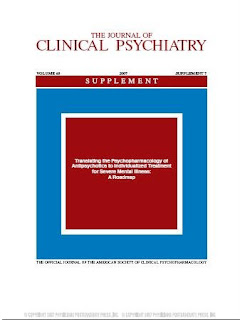 I just received the latest Supplement of the Journal of Clinical Psychiatry.
The Journal of Clinical Psychiatry, which is published by Physicians Postgraduate Press, Inc., and is edited by Alan J.
Gelenberg, has developed a reputation for publishing CME supplements which are biased in favor of the sponsoring drug company.
Thus, the current supplement, paid for by Bristol-Myers Squibb, reads like an advertisement for Abilify.
The supplement is titled "Translating the Psychopharmacology of Antipsychotics to Individualized Treatment for Severe Mental Illness: A Roadmap." Sounds promising to me, though rather vague.
The issue is billed as being the result of an "Expert Consensus Survey." This means that BMS paid a third party for-profit company, Comprehensive Neuroscience, Inc., to cherry-pick experts and to send them a list of questions about their favorite antipsychotics in various clinical situations. The responses were tabulated into a series of charts that form the backbone of this supplement.
To understand why BMS would choose this method of CME promotion, you have to understand the context. Their antipsychotic, Abilify (aripiprazole), was not included in the influential CATIE trial, because it was approved after the trial was completed. Thus, while Eli Lilly (Zyprexa), AstraZeneca (Seroquel), and Pfizer (Geodon) have been able to tweak CATIE results to their advantage, Abilify has little in the way of head-to-head science to back up claims of advantage over competitors. Commissioning an "Expert Survey" allows BMS to round up key opinion leaders who they already know have positive opinions about Abilify, choose questions about topics that will tend to play up Abilify's advantages, and then publish the pre-planned answers.
Let's look at the results of this novel form of drug comparison research.
The supplement highlights the results of 17 questions. Eight of these were questions about general strategies, and nine were quite specific, asking which of a list of specific antipsychotics the experts would favor in given situations. How do the experts rank Abilify in these nine questions comparing it with its direct competitors?
--In seven of these comparisons, Abilify is ranked number one (see page 30 of the supplement).
--In one comparison, Abilify is ranked number two (page 21).
--In one comparison, Abilify is ranked number three (page 26).
Oddly enough, Zyprexa was at the bottom or near the bottom in all of these rankings, even though some of these same experts have written elsewhere that Zyprexa was the most effective of all newer atypicals in the CATIE trial.
Why did Abilify come out on top? Because of the types of questions these experts were asked. Most questions asked which antipsychotic the experts would choose in patients who were overweight, had cardiac disease, or who had diabetes. This is a great way to stack the deck in favor of Abilify.
The expert panel's rankings would surely have been in favor of Zyprexa if they had been asked to choose an antipsychotic based on efficacy alone. Abilify would have ranked very low indeed if they had been asked to choose a treatment for patients who suffered insomnia, anxiety, or agitation. These are all important clinical questions in the field, but were not asked because the answers would not have promoted Abilify.
Shame on Journal of Clinical Psychiatry for publishing such pseudoscience.
 Yesterday, I described a patient who experienced transient severe jitteriness and shakiness on Abilify 5 mg/day. She did not want to discontinue it yet, and as I mentioned, I'll provide an update when I see her next.



 Subscribe to our RSS Feed!