skip to main |
skip to sidebar
 Lindsay DeVane, the Medical University of South Carolina professor who had described this article in CNS Spectrums as "commercial crap," is now defending said crap from its detractors.
Possibly responding to this letter just published in Psychiatric News, in which Harvard psychiatrist Alan Stone advocates officially "shaming" unethical colleagues who participate in ghost-writing, Dr. DeVane sent me the following e-mail:
"Dear Dr. Carlat, I am writing to say there should be no doubt about the integrity of the CNS Spectrums publication as an i3 CME certified activity. In particular, my unflattering characterizations of the CNS Spectrums article reflect the inherent limitations in providing practicing clinicians with fundamental descriptions of complicated issues. The initial draft of the article that was eventually published was written directly from the transcripts of the live CME televised broadcast last December and was not ghost-written. All three co-authors were heavily involved in multiple edits before agreement was reached on a final manuscript. Although my opinion is that antidepressant drug-drug interactions of major clinical significance are rare events, we all know that interactions can occur and the need for such awareness was a theme in the broadcast and article. My Neuropsychopharmacology commentary allowed a more complete discussion of some scientific issues, but there should be no question about the integrity of the CNS Spectrums publication as a CME activity. Lindsay DeVane."
I can only assume that Dr. DeVane must have been severely pressured by multiple parties to change his tune. You can read his earlier, and very different take, on the article in my prior posting here. At that time, Dr. DeVane called the first draft of the article a “ridicuous text… parts of it were inaccurate, simplistic, and [contained] over-generalizations.” The fact that he is now saying that this article was "written directly from transcripts of the live CME televised broadcast" is not exactly an endorsement of that Hawaiian event, which was funded by Bristol-Myers Squibb.
And although he is now saying that "all three co-authors were heavily involved in multiple edits before agreement was reached on a final manuscript," in his earlier letter, he stated, "I haven't even read the CNS piece, but from what you say, I probably shouldn't as it's likely embarassing. Please ignore it for purposes of interpreting my researchand views."
By the way, the founder of CNS Spectrums, James LaRossa, who knows all the players involved in this scandal quite well (in fact, he now publishes a different journal with both Nemeroff and DeVane on the masthead), said of the CNS Spectrums piece, "I am willing to bet dollars to doughnuts that Nemeroff never saw proofs of the article either."
As La Rossa commented further, "In truth, the CME business has become rotten to the core." I couldn't agree more.
 C. Lindsay DeVane, a Professor of Psychiatry and an author of an ACCME-accredited article published in the journal CNS Spectrums has termed his article a “piece of commercial crap,” and said he had not read the final version before it was published, according to an e-mail he sent to this writer (read his e-mail here).
DeVane, who is Professor of Psychiatry and Behavioral Sciences and Vice Chair for Research at the Medical University of South Carolina, is one of three authors listed for an “Expert Roundtable Supplement” published with the May 2007 issue of CNS Spectrums. The supplement was accredited and produced by i3 CME, a medical education company owned by Ingenix, and was funded by Bristol-Myers Squibb.
Responding in an e-mail to questions I had about the accuracy of the article (read this e-mail here), Dr. DeVane said that he had originally been approached by Dr. Charles Nemeroff to participate in a videotaped discussion to be held at a psychiatric meeting in Hawaii. The discussion was to be funded by Bristol-Myers Squibb, which recently released the antidepressant patch, EMSAM. DeVane initially declined Dr. Nemeroff’s invitation, saying that he did not want to participate in a “circus debate for the sake of selling CME time.” However, he eventually changed his mind and participated in a discussion of antidepressant drug-drug interactions with Nemeroff and Sheldon Preskorn, another high-profile academician who often consults and speaks for drug companies.
After the broadcast, the CME company, i3 CME, presented DeVane with an article based on the discussion, apparently ghost-written by a medical writer hired by the company. DeVane called this a “ridicuous text… parts of it were inaccurate, simplistic, and [contained] over-generalizations.” It is not clear whether DeVane insisted that editorial changes be made. He had not read the final version, and advised that the article be ignored “for purposes of interpreting my research and views.”
The controversy involves a seemingly arcane topic in psychopharmacology, the issue of how drugs interact with other drugs in the bloodstream. In an earlier article in a different journal, published without pharmaceutical funding, Dr. DeVane had argued that these drug-drug interactions were rarely significant when prescribing antidepressants. According to DeVane’s e-mail, that article “represents my summary of the field and opinions.”
The CNS Spectrums article, however, claims that these interactions are often significant when certain antidepressants are used. The article also points out that EMSAM, the drug made by the article’s sponsor, has the advantage of not sharing these drug interaction liabilities. If DeVane’s earlier statements had been used as the basis for the article, then EMSAM could not have been claimed to have this competitive advantage.
In response to inquiries about the discrepancies in DeVane’s earlier article and the newer article, CNS Spectrums and i3 CME did not comment on specifics, but denied any irregularities regarding the planning or writing of the article. According to their written statement, “the faculty [referring to Nemeroff, Preskorn, and DeVane] remains comfortable with the positions they have taken in this CME activity….”
File article under: Corruption in High Places
 On July 26, I sent CNS Spectrums a formal letter-to-the-editor outlining, in more genteel terms, the concerns about their commercially biased supplement on drug-drug interactions that I posted early this week here. I just received their response. It is the bland denial of wrongdoing that one might expect. There is no mention of Dr. DeVane's mysterious sea-change in his opinions about the clinical relevance of drug-drug interactions in EMSAM's competitors. Cheer up, truth fans. There is much more to this drama than meets the eye. Stay tuned.
August 14, 2007
Daniel Carlat, M.D.
Assistant Clinical Professor of Psychiatry
Tufts University School of Medicine
Editor-in-Chief
The Carlat Psychiatry Report
42 Pleasant Street
P.O. Box 626
Newburyport MA 01950
Dear Dr. Carlat:
We have had the opportunity to review your Letter to the Editor dated Thursday, July 26, 2007 regarding the Expert Roundtable Supplement “Antidepressant Drug-Drug Interactions: Clinical Relevance and Risk Management,” by Drs. Nemeroff, Preskorn, and DeVane.
We have forwarded your concerns to the faculty members, reviewed the activity planning and independent peer review processes, and examined the participant evaluations that have been received to date. Our findings include the following:
• The faculty remains comfortable with the positions they have taken in this CME activity, both in their presentations as well as how the question and answer section of the activity was addressed.
• Our independent review processes — both for MBL Communications and i3 CME — established that there was no concern of commercial bias with either the live activity or the subsequent enduring supplement.
• Evaluation reports show that 91% of the participants believe this supplement activity to be “objective,balanced and of scientific rigor”.
The ACCME’s Standards for Commercial Support were strictly adhered to and all decisions for this activity were made free of the control of the commercial interest. This includes the identification of the need, the determination of the educational objectives, the selection and the presentation of the content, and the identification of the persons that were in a position to control the content presented during the CME activity. In addition, the disclosure of commercial support was provided to the participants prior to the beginning of the activity as well as all relevant financial relationships of those planning members who had control over the content.
We would also like to note that the question and answer session is live and i3 CME has no influence on questions received from the audience. For many this is a rare opportunity to speak with the experts and questions received are not always directly related to the content.
Given the above information, it is our position that certifying this activity for AMA PRA Category I CreditTM is appropriate. Both our organizations have done due diligence in ensuring that this activity meets the standards for a certified medical education activity.
Sincerely,
Sandra T. Weaver, MS, Vice President, CME Program Development, Compliance Officer, I3CME
Darren L. Brodeur,, CEO & Publisher, MBL Communications, Inc., Publishers of CNS Spectrums, Primary Psychiatry, and Psychiatry Weekly
 No, that's not Carlat getting nasty and personal again. Those are the words of one of the most well-recognized names in American psychiatry, an academic of impeccable credentials who is involved in the industry-CME charade and is getting sick of it (insert the letters "r" and "a" to complete the headline--the spelled-out version was offensive to some). He will remain anonymous.
Why is he saying such terrible things about CNS Spectrums? He is referring to one of the most corrupt CME activities to hit the stands in a long time, and believe me, it takes a lot to impress this reporter.
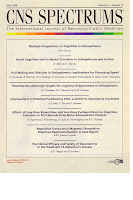
The article in question can be found in the May 2007 Supplement to CNS Spectrums, entitled, “Antidepressant Drug-Drug Interactions: Clinical Relevance and Risk Management,” (Nemeroff CB, Preskorn SH, DeVane LC, CNS Spect 12:5 (Suppl 7) May 2007).
According to my source, this sham article was originally a televised roundtable which was adapted by medical writers to form the basis for an industry-supported supplement. The CME company in question is i3 CME, which, my source said, wrote a "ridiculous text...parts of it were inaccurate, simplistic, and had overgeneralizations."
And yet, it was published anyway, and is accredited by the ACCME for 1 hour of Category 1 PRA credit.
The details of the science are a bit murky. But the short version is the Bristol-Myers Squibb, maker of the newly approved antidepressant EMSAM (transdermal selegiline patch), commissioned the article to convince doctors that EMSAM is safe to prescribe, even though it is an MAOI, which can produce fatal interactions with other drugs and with certain foods containing the amino acid tyramine. In order to deflect attention from this liability, the article dwells primarily on a drug-drug interaction in which EMSAM is safe: interactions involving the liver's P-450 enzyme system. Indeed, EMSAM neither inhibits nor induces these enzymes, meaning that it won't affect the levels of other medications that are metabolized in the liver.
Of course, this is an "advantage" only if drug-drug interactions are problematic for other antidepressants. The article works hard to make the case that two SSRIs, Prozac (fluoxetine) and Paxil (paroxetine), are dangerous medications because of drug-drug interactions: "To put these numbers in perspective, fluoxetine and paroxetine at 20 mg/day produce approximately a 500% increase in the AUC of CYP2D6 dependent drugs" (see page 6).
But this opinion directly contradicts what one of the authors recently wrote in a non-commercially funded article published in the journal Neuropsychopharmacology, at that time edited by Dr. Nemeroff, who happens to be the first author of the CNS Spectrums piece. According to my source, Dr. Nemeroff spearheaded this CNS Spectrums EMSAM advertisement "for the sake of selling CME time."
At any rate, in that earlier unfunded article, Dr. DeVane, the third author of the CNS Spectrums piece, wrote: "Dr. Preskorn and Dr. Werder's commentary is confusing because it frequently fails to distinguish between verifiable statements and personal opinion, includes dubious extrapolations of data (eg 'lowest effective dose of fluoxetine and paroxetine produces approximately a 500% increase in the plasma concentration of co-prescribed [CYP2D6] drugs')" (Neuropsychopharmacology 31:1594-1604, 2006).
With a sprinkling of industry money, an opinion that was once a "dubious extrapolation of data" becomes a fact. While I'm no fan of industry-funded CME, in this case there was a silver lining: old foes (Dr. DeVane and Dr. Preskorn) were reunited.
By the way, I have nothing against EMSAM, but I rarely prescribe it because most patients don't want to have to hassle with wearing a patch. Generally, if I want to prescribe an MAOI, I'll prescribe oral Parnate or Nardil.
In the CNS Spectrums parallel universe, however, patients appear to be yearning for a patch. The article ends with the following promotional comment by Dr. Nemeroff: “I have had more and more patients say to me, “I really think that I would like to try selegiline transdermal system. I do not like taking pills.”
Carlat Blog Verdict: CNS Spectrums: The very definition of a "throwaway" journal.
 Lindsay DeVane, the Medical University of South Carolina professor who had described this article in CNS Spectrums as "commercial crap," is now defending said crap from its detractors.



 Subscribe to our RSS Feed!