One of the benefits of having the Carlat World Headquarters here in beautiful Newburyport, Massachusetts is that we get to work next door to an iconic antiques barn called Oldies. It's a wonderful stockpile of odds and ends that range from decommissioned lobster traps to faded movie posters.
The other day I came across an old issue of LIFE Magazine with a cover story on “The Dangerous Diet Pills: How Millions of Women are Risking their Health with Fat Doctors.” The date? January 26, 1968, which was smack dab in the middle of the amphetamine epidemic that prompted Congress to pass the bill creating our current system of scheduled, and controlled medications.
What, if anything, does this issue of LIFE teach us about the potential dangers of Vyvanse’s recent approval for binged eating disorder? This “exclusive report” was based on investigative journalist Susan McBee’s undercover visits to 10 “fat doctors.” She was given cursory exams and, although she was not overweight (5’5”, 125 pounds), virtually every physician prescribed her various pills, including amphetamines, barbituates, sex hormones, and diuretics. One office insisted she pay cash--no personal checks--in order to receive the pills.
How is this nearly 50-year-old article relevant to the age of Vyvanse? This was a story of unscrupulous doctors running pill mills for women who wanted to lose weight. The diagnostic process--if there was one--was sloppy and all-inclusive. If you came to one of these doctors requesting amphetamine, you were assured of getting a script, regardless of your diagnosis.
As a recent New York Times article shows, history is repeating itself. The Affordable Care Act has a provision requiring coverage of obesity treatment, and doctors are taking advantage of this by opening chains of lucrative weight loss clinics. Some are selling medications directly to patients, such as phentermine, which, like Vyvanse, is an stimulant.
It seems only a matter a time before Vyvanse pops up in the menu of options for patients being seen by the new breed of diet doctors.
Don't get me wrong--Vyvanse is effective for binge eating disorder, as we discussed in our recent CME article (subscribers to The Carlat Psychiatry Report can read it here).
If a patient came to me and said, “Doctor, I’ve heard about Vyvanse for binge eating, and I’d like to try it,” I would carefully ask about their eating habits in order to establish an actual pattern of binge eating. But what if the patient was more of a grazer than a binger? What if I sensed that the patient was simply looking for a weight loss drug and had no binge eating problem at all? I wouldn't prescribe a drug that has a high risk of abuse and diversion.
As was true in 1968, doctors are free to prescribe meds for indications not approved by the FDA. I predict that many women (and men) will be asking for Vyvanse to lose weight, and will walk away with the prescription, whether or not they have BED.
It's been nearly a half century since the LIFE article, and we're still prescribing speed for weight loss Let’s not let it get out of hand.
Wednesday, August 5, 2015
Wednesday, July 1, 2015
Hospitality and Pharma: Relationship on the Rocks?
It used to be a veritable love-fest. As recently as 2011, I was writing about a restaurant's attempt to rebrand itself as a "pharmaceutical dinner facility." In 2010, I debated a restaurant chain owner who was calling for the Massachusetts legislature to repeal the state's 2009 gift ban so drug companies could once again wine and dine doctors at his restaurants. His lobbying turned out to be successful. The state's previously strict law was revised in 2012. Now it allows industry representatives to purchase meals of a "modest value" outside the office or hospital as long as they provide educational information about their products between courses.
However, it turns out that while hospitality industry owners are working double time to book reservations for doctors and pharmaceutical reps, their employees have an entirely different idea. They--correctly--see drug company relationships with doctors as a driving force in their rising health care costs, and they want pharmaceutical companies to stop funding educational CME programs at their hotels.
Last week I wrote about this brave stance from the hospitality worker's union Unite Here ("Hotel Workers Against Industry-Funded CME?"). The Wall Street Journal's Pharmalot blog got in touch with me to discuss the matter further and yesterday they posted a follow up that includes more of my thoughts on the matter and more of ACCME's self-serving response.
Looking back over the recent history of these industry dynamics, it's easy to see more workers taking this stand against business as usual. After all, they go to work every day in the middle of a money storm while simultaneously seeing their health costs rise year after year. That's a pretty good reason for them to want to stand up.
You can help them out by signing the No More Drug Money petition they are promoting and by sharing it around.
Friday, June 26, 2015
Hotel Workers Against Industry-Funded CME?
In a fascinating new chapter in the battle over industry funding of CME, a huge hotel workers' union has started a campaign to end the practice. Unite Here represents 270,000 workers, and the organization claims that industry funding of CME drives up their health care costs, which is undoubtedly true. So they have created a website, No More Drug Money, to advocate their cause, and they are inviting us all to sign the Pledge: "Add your name here to encourage the ACCME to kick drug money out of CME for good."
You have to respect an organization willing to bite the hand that feeds them. Hotel workers are, after all, an integral part of the grand machinery transporting industry marketing messages into the hearts and minds of doctors. They're quite aware of this:
For ACCME's formulaic response, click here.
Industry funding of medical education, whether accredited CME or promotional talks, has always created strange bedfellows, but now it has created particularly strange antagonists.
You have to respect an organization willing to bite the hand that feeds them. Hotel workers are, after all, an integral part of the grand machinery transporting industry marketing messages into the hearts and minds of doctors. They're quite aware of this:
"We work in hotels, airports, and convention centers, and we do the hard work that make many CME meetings run. We cook the food, we change the sheets, we do the laundry, and we pass out the agendas. We see first-hand what kind of presence pharmaceutical companies have during these meetings. And we are ready for a better system."
For ACCME's formulaic response, click here.
Industry funding of medical education, whether accredited CME or promotional talks, has always created strange bedfellows, but now it has created particularly strange antagonists.
Sunday, May 17, 2015
The GeneSight Test: A Wing, a Prayer and 13 Patients
We just published the May issue of The Carlat Psychiatry Report, and the topic is "Biomarkers in Psychiatry."
I contributed an article reviewing the evidence for the GeneSight genetic test, which is being quite heavily marketed as a way to choose the right medications for patients. According to company's website:
"Multiple clinical studies have shown that when clinicians used GeneSight to help guide treatment decisions, patients were twice as likely to respond to the selected medication."
That's misleading, I found. The vast majority of the GeneSight data are based on studies with an unreliable methodology. These were so-called "open label" studies in which patients were non-randomly assigned to two groups: guided treatment vs. unguided treatment. All patients and clinicians knew which patients were assigned to which group, leading to the very real possibility of various biases--along with a heavy helping of the placebo effect.
One single randomized, blinded study has been published (not even properly blinded, since the clinicians knew which patients were in which group). It enrolled 49 patients (25 in the guided group, 24 in the unguided group). There was no significant difference in the depression improvement scores between the groups. There was a secondary analysis of 13 patients showing a potential benefit for those whose meds were categorized by the test as being particularly problematic.
13 patients? I don't think I would use a genetic test based on good results from an N of 13--and I would suggest that you think twice before you do so!
By the way, I'm at the APA meeting in Toronto and will be going to a lecture today sponsored by Assurex, the maker of GeneSight--if I learn anything new I'll let you know.
I contributed an article reviewing the evidence for the GeneSight genetic test, which is being quite heavily marketed as a way to choose the right medications for patients. According to company's website:
"Multiple clinical studies have shown that when clinicians used GeneSight to help guide treatment decisions, patients were twice as likely to respond to the selected medication."
That's misleading, I found. The vast majority of the GeneSight data are based on studies with an unreliable methodology. These were so-called "open label" studies in which patients were non-randomly assigned to two groups: guided treatment vs. unguided treatment. All patients and clinicians knew which patients were assigned to which group, leading to the very real possibility of various biases--along with a heavy helping of the placebo effect.
One single randomized, blinded study has been published (not even properly blinded, since the clinicians knew which patients were in which group). It enrolled 49 patients (25 in the guided group, 24 in the unguided group). There was no significant difference in the depression improvement scores between the groups. There was a secondary analysis of 13 patients showing a potential benefit for those whose meds were categorized by the test as being particularly problematic.
13 patients? I don't think I would use a genetic test based on good results from an N of 13--and I would suggest that you think twice before you do so!
By the way, I'm at the APA meeting in Toronto and will be going to a lecture today sponsored by Assurex, the maker of GeneSight--if I learn anything new I'll let you know.
Thursday, April 30, 2015
How Drugs Collide: What Every Psychiatric Prescriber Should Know
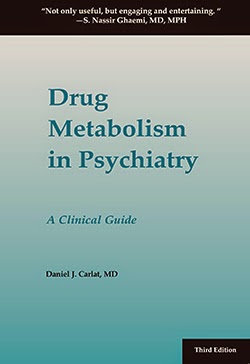
I just published a new edition of my book, Drug Metabolism in Psychiatry: A Clinical Guide. You can buy it here, and you can read a free preview of the first two chapters here.
It's mostly a book for psychiatrists and psychiatric nurse practitioners. It's pretty short at 145 pages, but it's very concise and in my opinion fun to read.
If you are not a prescriber you might also find it useful because it explains in clear language how we make decisions about which drugs to prescribe based on how they are metabolized. Therapists, patients, and those simply interested in psychiatry might find it educational, and strangely entertaining.
Anyway, that's it. Sorry if you were looking for a piece of muckraking investigative journalism. Maybe next time!
Thursday, April 16, 2015
How a New Blood Test for Depression is like Apple Recognition
Four years ago I wrote a blog post about the MDDScore blood test for depression. That was before there were any peer-reviewed publications describing it. Now there are at least two. The latest came out a couple of months ago in the Journal of Clinical Psychiatry, and you can access the article, along with two interesting commentaries, for free.
While I won't go into the article in any detail, suffice it to say that the overall accuracy of the test for diagnosing depression was between 91% to 94%, depending on the group studied. Based on this, the authors report that the test "has excellent performance in confirming a diagnosis of MDD (major depressive disorder)."
The article is a classic example of the pitfalls of focusing on glitzy-sounding statistics while downplaying the actual clinical usefulness, which in this case is close to nil, as both of the Journal's commentators agreed.
I recently discussed the same problem in an article I wrote for CCPR about the NEBA EEG test for ADHD. Like the MDDScore, the NEBA test promises to aid in the diagnosis of a psychiatric illness. The NEBA's accuracy is high, with a positive predictive value for ADHD of 96% for kids, and 81% for adolescents. But no matter how accurate it is, the crucial question is whether it adds value above and beyond the standard psychiatric interview. Neither the MDDScore nor the NEBA do.
In my article, I used a hypothetical analogy of a new test to diagnose apples:
While I won't go into the article in any detail, suffice it to say that the overall accuracy of the test for diagnosing depression was between 91% to 94%, depending on the group studied. Based on this, the authors report that the test "has excellent performance in confirming a diagnosis of MDD (major depressive disorder)."
The article is a classic example of the pitfalls of focusing on glitzy-sounding statistics while downplaying the actual clinical usefulness, which in this case is close to nil, as both of the Journal's commentators agreed.
I recently discussed the same problem in an article I wrote for CCPR about the NEBA EEG test for ADHD. Like the MDDScore, the NEBA test promises to aid in the diagnosis of a psychiatric illness. The NEBA's accuracy is high, with a positive predictive value for ADHD of 96% for kids, and 81% for adolescents. But no matter how accurate it is, the crucial question is whether it adds value above and beyond the standard psychiatric interview. Neither the MDDScore nor the NEBA do.
In my article, I used a hypothetical analogy of a new test to diagnose apples:
"Let’s imagine that there’s a new apple-recognizing device on the market called the “Apple Rec,” which uses various technologies to measure the wavelength of light reflected by an object, its mathematical curvature, etc. The manufacturer provides impressive data showing that the Apple Rec has 100% sensitivity and 100% specificity for diagnosing (recognizing) an object as being an apple. Given these dazzling statistics, would you buy the Apple Rec? No, because even though it’s exquisitely accurate, it provides you with no useful diagnostic information beyond what you can obtain by looking at the apple yourself. However, if the Apple Rec provided you with added value, you might consider it a good investment. For example, if, in addition to correctly recognizing it as an apple, it also calculated its sweetness and crispness, the Apple Rec suddenly becomes a useful tool, because these are qualities that you would otherwise struggle to ascertain."
The apple principal applies to diagnostic tests in
psychiatry. Before you refer your patients to an expensive test that diagnoses
ADHD, depression, or anything else, you need to make sure that it does something that you can’t easily do
yourself.
Wednesday, April 15, 2015
Medscape Presents: The Brintellix Show
As I wrote in part one of my Medscape review, the website gets high marks for up-to-the-minute coverage of psychiatric
news, and it deserves kudos for posting a ton of textbook-like content on
disorders and drugs. I wasn’t so thrilled with its "un-privacy" policy, which
results in your personal info and browsing history being sold to third parties.
Brintellix (vortioxetine) Background
The more crucial question is not "how many ways can one drug manipulate 5-HT" (even the manufacturer states the "clinical relevance" of the drug's many serotonin actions is "unknown") but rather "how many ways can one communication company manipulate doctors's prescribing practices?"
To make their point crystal clear, one of the experts in the video glowingly endorses Brintellix, saying that its multimodal mechanism is like packing a bunch of great medicines into one:
Today we get into the dark side of Medscape
Psychiatry, which is their industry-funded CME.
Medscape Psychiatry CME Overview
Medscape offers four different categories of CME on its “CME and Education” page. "Clinical Briefs" and "Journal Articles" are mostly not industry funded, whereas "Patient Cases" and "Knowledge and Practice" are generally industry products.
Brintellix (vortioxetine) Background
To give you a little context, Brintellix is the latest antidepressant to be FDA approved. It is being marketed as a "multimodal" antidepressant because it has effects on several different receptor sites. The company has produced some interesting data showing that Brintellix may cause fewer sexual side effects than other antidepressants, and that it may help improve the slowed-down thinking that is common with depression. But it is not FDA approved for either of these potential advantages, because thus far, the data are far from definitive.
Medscape and Takeda/Lundbeck
Medscape is the largest single recipient of pharmaceutical CME grants among all U.S. medical communications companies. According to an article in JAMA, it received $20,315,730 in 2010, the last year for which such data were aggregated. I don't know how much the company is receiving from Takeda/Lundbeck for producing CME programs, but it's probably a lot. If you click through Medscape's most technologically sophisticated online courses, a high proportion are funded by this duo.
Here are some of the titles of the courses:
Medscape and Takeda/Lundbeck
Medscape is the largest single recipient of pharmaceutical CME grants among all U.S. medical communications companies. According to an article in JAMA, it received $20,315,730 in 2010, the last year for which such data were aggregated. I don't know how much the company is receiving from Takeda/Lundbeck for producing CME programs, but it's probably a lot. If you click through Medscape's most technologically sophisticated online courses, a high proportion are funded by this duo.
Here are some of the titles of the courses:
- Strategies for Effective Communication With Patients With Major Depression
- Strategies for Improving Symptoms in Patients With Major Depression
- Engaging Patients as Partners in Care: The National Quality Strategy in Practice
- Cognition in Major Depressive Disorder: Improving Quality of Life
- Updates and Perspectives in Major Depressive Disorder: Highlights From 2014
- The Pharmacology of MDD Treatment: Building a Foundation With a Focus on 5-HT
Commercial Bias in One of the Courses
All of the courses listed above are likely biased in favor of Brintellix--there wouldn't be much point in paying Medscape to produce them otherwise. Since blogging is not my day job, I chose only one of them to watch: The Pharmacology of MDD Treatment: Building a Foundation With a Focus on 5-HT.
This course begins with four multiple choice questions, which are supposed to test your knowledge before you learn. Here's one of them:
All of the courses listed above are likely biased in favor of Brintellix--there wouldn't be much point in paying Medscape to produce them otherwise. Since blogging is not my day job, I chose only one of them to watch: The Pharmacology of MDD Treatment: Building a Foundation With a Focus on 5-HT.
This course begins with four multiple choice questions, which are supposed to test your knowledge before you learn. Here's one of them:
Which of the following
antidepressants manipulates the most serotonin receptors at once?
vilazodone
selegiline
quetiapine
vortioxetine
The correct answer? Vortioxetine.
This is a clever way to prime the pump, to get the audience thinking about the promoted drug.
Next, we get a slide purporting to give an overview of the history of antidepressant drug development.
The big red bubble labeled MMD refers to "multimodal drug", ie., vortioxetine. That's the latest one. The implication is that it's the most technically advanced.
Later in the program, there are a few slides highlighting "new antidepressants." Only one antidepressant gets prominently featured on two slides:
The more crucial question is not "how many ways can one drug manipulate 5-HT" (even the manufacturer states the "clinical relevance" of the drug's many serotonin actions is "unknown") but rather "how many ways can one communication company manipulate doctors's prescribing practices?"
To make their point crystal clear, one of the experts in the video glowingly endorses Brintellix, saying that its multimodal mechanism is like packing a bunch of great medicines into one:
"Vortioxetine is a great
example of this multimodal thing we were talking about. It is a serotonin
reuptake inhibitor, but it also is a very strong agonist at 5-HT1A,
which we said you want to have an agonist there. It also is a powerful antagonist
at 5-HT3 which and a powerful antagonist at 5-HT7.
On paper, here is a drug that has some of these qualities we have been talking
about that could make it possibly a multimodal agent almost like a built in
augmentation strategy in 1 pill, which certainly would be, just practically, a
little easier for patients than having to take more than 1 medicine, which we
often have to do.[3-6]"
A bit later, he goes even further, implying that Brintellix uniquely targets three common symptoms of depression:
"Again, right now, the data clearly show the 3
most common residual symptoms, even with people who have a response to an
antidepressant are insomnia, cognitive impairment, and fatigue. I think those
are things that are not well addressed by an SSRI alone. Thinking more
sophisticated, multimodal actions whether it is 1 pill that has that built in
augmentation. I think that is where the field is going."
Summing up Medscape
Since the last time I reviewed a psychiatric website, I assigned a letter grade, I'll give Medscape one as well: a B-.
Why? It gets an A for delivering bite-sized psychiatric news clips on its non-CME page, an A- for providing free but dry drug and disorders info, and an F for failing to comply with Standard 5 of ACCME's Standards for Commercial Support in its CME courses. Among other things, Standard 5 forbids a CME program from promoting a "specific proprietatry business interest of a commercial interest", and it requires that presentations "must give a balanced view of therapeutic options."
I'm surprised that Medscape is still resorting to these shenanigans, but I guess that's what butters their bread.
Subscribe to:
Posts (Atom)


Subscribe to our RSS Feed!